

Pros and Cons of FUE Hair Surgery


Pros and Cons of FUE Hair Surgery
Today we will gonna explain the FUE procedure's pros and cons. FUE is very popular and gaining in popularity. But it’s important that everyone should know about what are the benefits and what are the disadvantages of this procedure.
If you go onto the internet you would think there are only pros and no cons. I’m afraid is our sad duty to tell you that everything has its pros and everything has its cons.
Today we’ll focus on the benefits and the risks associated with FUE.
What is FUE?
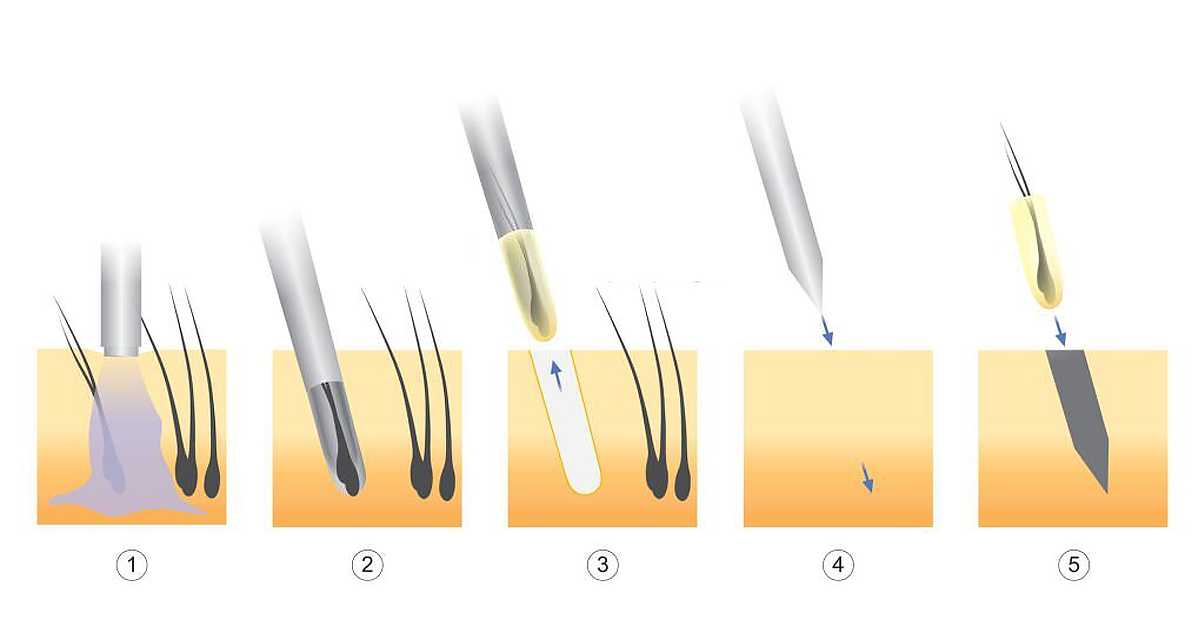
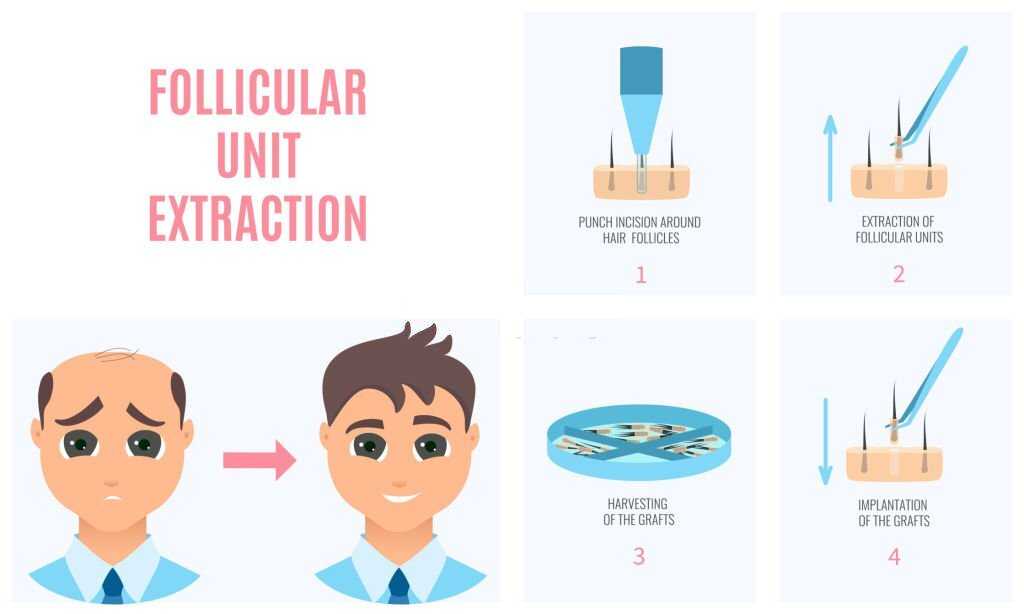
FUE is a great procedure. Just to recap quickly basically what we’re doing from the back of the head we’re taking little punches of follicular units of grafts that create a tiny little dot-like scar and we’re scattering them over the entire back of the head. Then we extract those one at a time and we make the recipient sites and we plant those there.
Let’s remember we’re creating a hole because we’re taking out a cylinder and a very small cylinder with full-thickness skin. We’re creating a hole in the back of the head.
The only way that hole can fill up is by a scarring process from the bottom of the skin through to the top of the skin. We call that healing by secondary intention.
As the scar comes that column of scar comes up it’s a cylinder of scarring that’s created there it does tend to contract but it is a scar nonetheless.
Is FUE plucking hairs?
People need to understand that it’s not plucking hairs. People come in with this idea FUE is plucking hairs. We’re not with cutting skin because hair is an organ of the skin.
if we pluck the hair and plant the hair won’t grow because it doesn’t have enough stem cells correct to actually create a new hair. You need to take the stem cells which reside in the skin.
I’m just emphasizing to you we have to create these holes because we have to take these cylinders of skin that have stem cells in them.
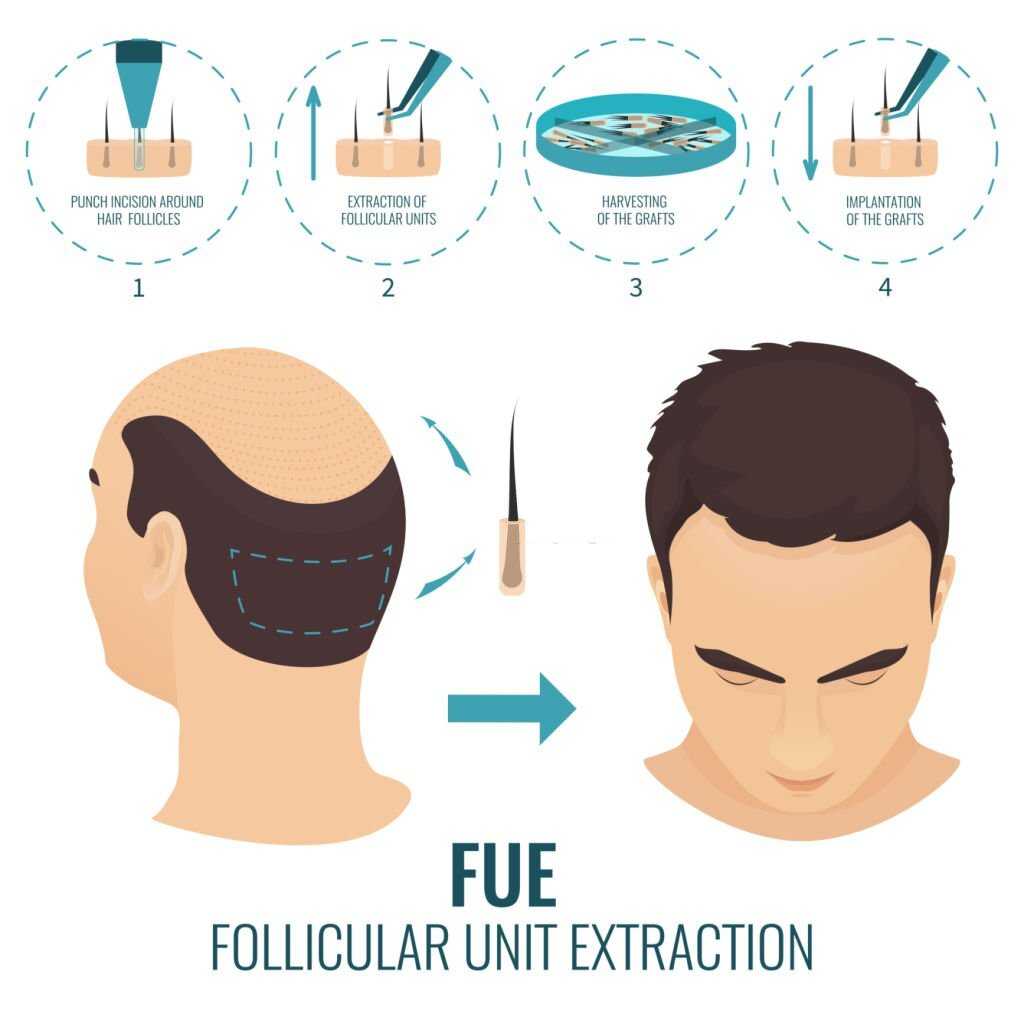
This is a cross-section of the skin with the graph. What we’re doing is we’re cutting out a cylinder of tissue that incorporates both the hair and the bulb the root with the stem cells in it.
We’re going down to the fat layer so it is a steadily surgical procedure that we’re performing and then once that’s left it leaves you with a cavity that over time will slowly heal up.
How long does the healing process of the FUE cavity take?
That takes about 7 to 10 days. Just emphasizing that all the surgeries that are done for hair transplantation create scarring it’s just different types of scar. If it’s been taken properly it doesn’t regrow.
Pros of FUE Hair Transplant
- No linear scars
Let’s talk about the pros of doing FUE. A con of FUT becomes a pro of FUE and that is no linear scar. Yes, there are dots scars but no linear scar. Patients feel that this seems a bit like a little bit less surgical, less invasive.
- Wearing a shorter hairstyle
The other advantage that they feel they have is they can wear a shorter hairstyle. If the harvesting has been done properly you can wear your hair super short so like a buzz cut a number 1 or 2.
I do emphasize if it’s done properly because if we over-harvest an area then it becomes see-through. If we take too much hair out and people come to us with different degrees of density different quality of their hairs, even if you do the beautiful technique of taking them out and not damaging the hairs you know if you take too much over the area that becomes noticeably thinner and see-through compared to the surrounding hair.
It requires not just the advantage of these but it also requires good technique.
- Expands donor area in patients with previews FUT surgery
If we do strip surgery first from the scalp when it has its most flexibility we’re taking the hair from that area and we’re using it and then as the patient gets older the balding gets larger the scalp flexibility has become reduced, it’s become harder to take more strip scars.
Because: It’s tight and you don’t want that linear scar too close to a future balding area.
You can cherry-pick your hair using FUE so this is expanding the donor area. For people, if they’re prepared for FUT as well as using FUE. FUE can expand the donor area in these patients. It’s not expanding down in everybody but it expands the donor area in the strip, in patients with previous strip surgery.
- Patients with strip surgeries can use FUE
I’m quite happy to tell everybody that these patients who have had previous strip surgeries can come back and have FUE carefully done. As not to expose the linear scar because if you take out too much hair above or the donor scar from a previous FUT surgery you’re going to expose the scar.

It has to be done in a sensible way but it expands the donor area in strip patients. As our patients are living longer and longer I would argue that means are getting bolder and bolder.
- FUE is future proof
Again we need to think about the future, we have to bang on about this planning 10, 15, 20 years down. The modern era of instant gratification is completely against the way we want to treat baldness. If baldness was not a progressive condition this would become irrelevant but baldness is unpredictable and you should consider it.
Everybody that comes to you to see us is going to have less hair in 5 years' time 10 years time 20 years times so we have to do our thinking with them to plan for that potentiality.
Cons of FUE Hair Transplant
- Thining of a donor area
The con here is that you’re only taking 20% of the hairs out of an area. If you need a large number of grafts you need a large harvest area. If you are using a large harvest area then you can if you take too much out of an individual area you get thinning see-through donut area. That’s the first problem.
- Safety of the donor's hairs
The second problem is the safety of the donor’s hairs. If you’re trying to gradually thin a large area using FUE, which is really what you’re trying to do, gradually thin a large area by definition in people with crown balding.
Particularly for our younger patients with crown balding, we are forced to go closer to the balding margin to take those hairs out. If you take out a hair that later on becomes a thinning or balding area firstly the dot scars become more visible secondly you lose the grafts on the top of the head.
- Creating scars on the scalp
It’s critically important that these hairs are chosen and we are making life difficult for ourselves in some patients if we’re trying to harvest just using FUE as our technique. People forget that you are creating scars and I’m not going to call that a con because it would be a con for FUT as well. Both techniques are creating different scars.
That’s an important thing because a lot of people say it’s scarless but when they’ve had FUE and they expect they want to be able to shave their head at the back of their head and they go:
Hey, I can see the little tiny little dots that are spread over a large area!
Yes, that is the minimally scarring that you’ve got from the FUE procedure.
- Harvesting grafts in the riskier areas of the scalp
Here is another catch that people don’t think about. If you were trying to gradually evenly thin out an area if you’re using a large number of graphs, where you haven’t harvested still has the most density and that could look like an area zone that just looks thick compared to everything else.
So you’re forced to go into that zone to thin it a little bit so it doesn’t look noticeably thicker than the surrounding hairs. And guess where that zone is? It is right below the balding margin.
Now you are having to go and harvest in these riskier areas because otherwise they get this zone full density with significant thinning below it and balding about it and it just doesn’t look right. It’s like there’s a patch thereof thick hair and they are forced to go into an area that they know is potentially a future problem.
- Getting hairs from the dangerous scalp zone
I’m going to call it a zone look. This is different from thinning of the donor area because thinning of the donor area comes from over-harvesting in that area. We are trying to avoid that margin that is next to the balding area but in doing so you run the risk of there being this differentiated area.
That means that if you’re practicing a little bit of caution in your decision-making and you know that you need a large number of grafts you need to think very carefully about this.
The younger you are and you’re thinking about a large number of grafts more carefully you need to think about this.
- The consequence of bad planning
Unfortunately, there’s a trend around the world for people to do cosmetic medical tourism where they go to places that are famous for their FUE surgeries because they do huge numbers of grafts in one session.
We often see these advertisements and these patients are going somewhere to get 5000 to get 6000 FUE grafts done in a single session. This sounds like a tremendous boom to the patient because this bald patient can have this massive amount of hair planted in their head in one day.

The real problem for these patients because they’re often in their 20s and 30s is that if you’ve taken 4000 or 5000 of these FUE grafts out from this area. It’s a very large area, it’s a large harvest, there’s probably a lot of density being taken out of the areas there’s not much left for future needs using that technique.
If you lose more hair and the balding margin comes away from the grass and leaves you this rim of baldness that we see all the time happening to our patients as the baldness appears. there’s really not much left in the donor area to deal with it. I know that we’re preaching a conservative viewpoint here but the reason is that future balding is unpredictable.
That’s probably where FUE in my mind has a slight limitation. If I’ve got someone who’s got a large amount of balding I’m more inclined to go maybe you’re better off with strip FUT surgery.
I think FUE ease you’re doing a lot more of a comfort zone if you don’t have a large harvest that you need to do because you’re not over-harvesting from the back, you’re not getting too close to any riskier areas that may get bald in the future.
If you’re within those parameters you’re in a nice clean comfort zone. I know a lot of surgical knows we can harvest large numbers but when you do that you run the risk of getting into tiger country.
I sort of limit it to a certain extent. We still do a few thousand and with FUE. But I don’t go as aggressively as I probably would with strip FUT.
- You can't shave the donor area
We’ve got one more con and that is you have to shave the donor area. If you’re using a robotic technique for harvesting, there is a robot that does this it relies on video. If it relies on video it can only do it only with short hair.
So the hair has to be shaved down to one millimeter in length for the robot to work. It’s a lot easier for FUE surgeons to do it if they do shave FUE. Non-shaved FUE, where you either just trim out just the head you want to take it’s very slow and very time-consuming, or trying to do long hair if you even that’s technically possible, it’s a very time-consuming very difficult skill to master. You can’t do a large harvest.
The reality is we shave the donor area. For people that need to get back to work and don’t want to see the bandage on the back of the head because there are holes there, remember what we talked about a thousand FUE grafts means a thousand holes, in the back of the head. Then put a bandage on for the first night.
But then you’ve got every one of those a thousand holes develops a thousand scabs and those thousand scabs become a thousand scars at a time. It’s not instantly invisible it takes a couple of weeks for the hair to grow back after the scabs to settle and for it to settle down and you can have a little pink mark.
You’re really making it difficult for yourself to have it as an invisible surgery for those around the initial unit in the initial phase.
FUE in women
The other thing that we shouldn’t forget is women. I’ve met a female that was required hair transplant surgery that thought it would be a really good idea for me to shave the back of their head, I haven’t.
Women often only have decent hair at the bottom back of the scalp. If you only have a small area but you have a lot of thinning on top, taking a 100% of the hairs out of the area you harvest from that smaller area there’s going to give you more play with on the top of the scalp than trying to do FUE where you are trying to take 20 or 25% of the hair out of the area.
For people with restricted donor areas, it’s a disadvantage to use FUE because if you got a restricted donor area you can’t get a lot of grafts.
Final thoughts
Just to reiterate I think they’re both excellent procedures and sometimes it does matter what you choose. We’ve tried to do is to talk you through our thought process so you understand how we would approach different patients coming to us.
We would think of different ways there was the most appropriate approach both initially and later on for that patient based on a number of factors which we’ve discussed age, degree of balding, unpredictable future hair loss, how big the balding area is, how quickly they want to get back to work without anybody noticing.
There are a whole bunch of factors that go into the decision-making. We find that we’re very happy to offer both of those but we want to give the patient good information before they make that decision. It’s really important to make an informed decision and hopefully having this knowledge can help you in that process so when you do meet someone to discuss this. You are well armed with that so you can have an informed discussion with them.


